IES
North American photometric exchange format commonly used for candela distribution and lighting calculations.
Check: test sample, wattage, orientationIES / LDT / COLOR / THERMAL
A specification center for understanding what each file measures, which operating condition it represents and where simulation stops short of full luminaire validation.
North American photometric exchange format commonly used for candela distribution and lighting calculations.
Check: test sample, wattage, orientationEULUMDAT format used by many European lighting workflows to describe intensity distribution and luminaire geometry.
Check: coordinate system and symmetryFidelity, gamut and hue-shift information adds application context beyond CRI alone.
Check: CCT and operating currentComponent lumen-maintenance test data and projection methods inform design; they are not finished-luminaire lifetime tests.
Check: case temperature and durationRequest the file set that corresponds to the selected LED source and operating condition. Generic family data can support early comparison but should not be treated as final submittal evidence.
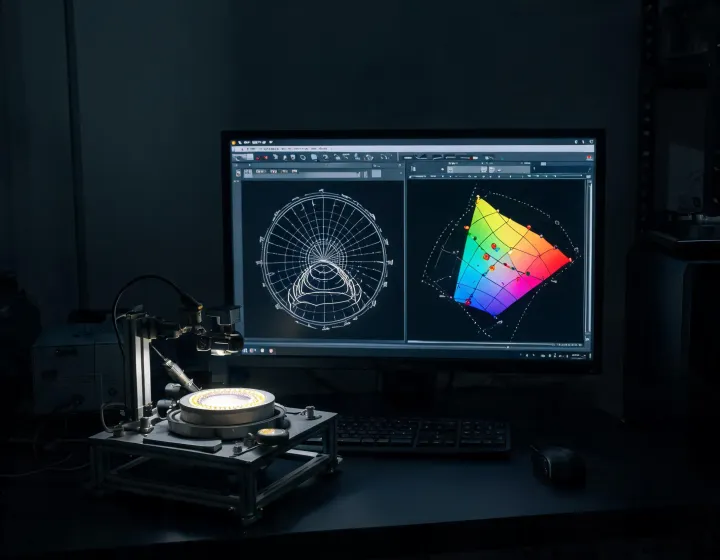
IES/LDT data, coordinate notes and test-condition identification for simulation.
Spectral power distribution, CCT, CRI and available TM-30 context.
Applicable LM-80 data, TM-21 interpretation boundaries and thermal-design inputs.
Match the part, revision, drive current and temperature condition to the project candidate.
Import distribution data, set geometry and calculate illuminance, uniformity, UGR or relevant application metrics.
Build the intended optic, driver and thermal path; stabilize the assembly before recording electrical, photometric and color results.
Compare the physical result with the simulation and document tolerances, instrumentation, ambient conditions and acceptance criteria.
Maximizing lm/W can reduce system power, while tighter glare control, higher color quality or broader distribution may reduce nominal efficacy. Select against the application requirement, not one metric.
Integration can improve package size and thermal control. Replaceable sources or drivers may reduce maintenance disruption. The preferred path depends on access, duty cycle and ownership horizon.
IES/LDT files represent measured samples and stated conditions. Optical accessories, production tolerances, temperature and installation geometry can change field performance; on-site verification remains necessary.
Include the source family, current, CCT, optical configuration and intended calculation software.
Request Photometric Resources